
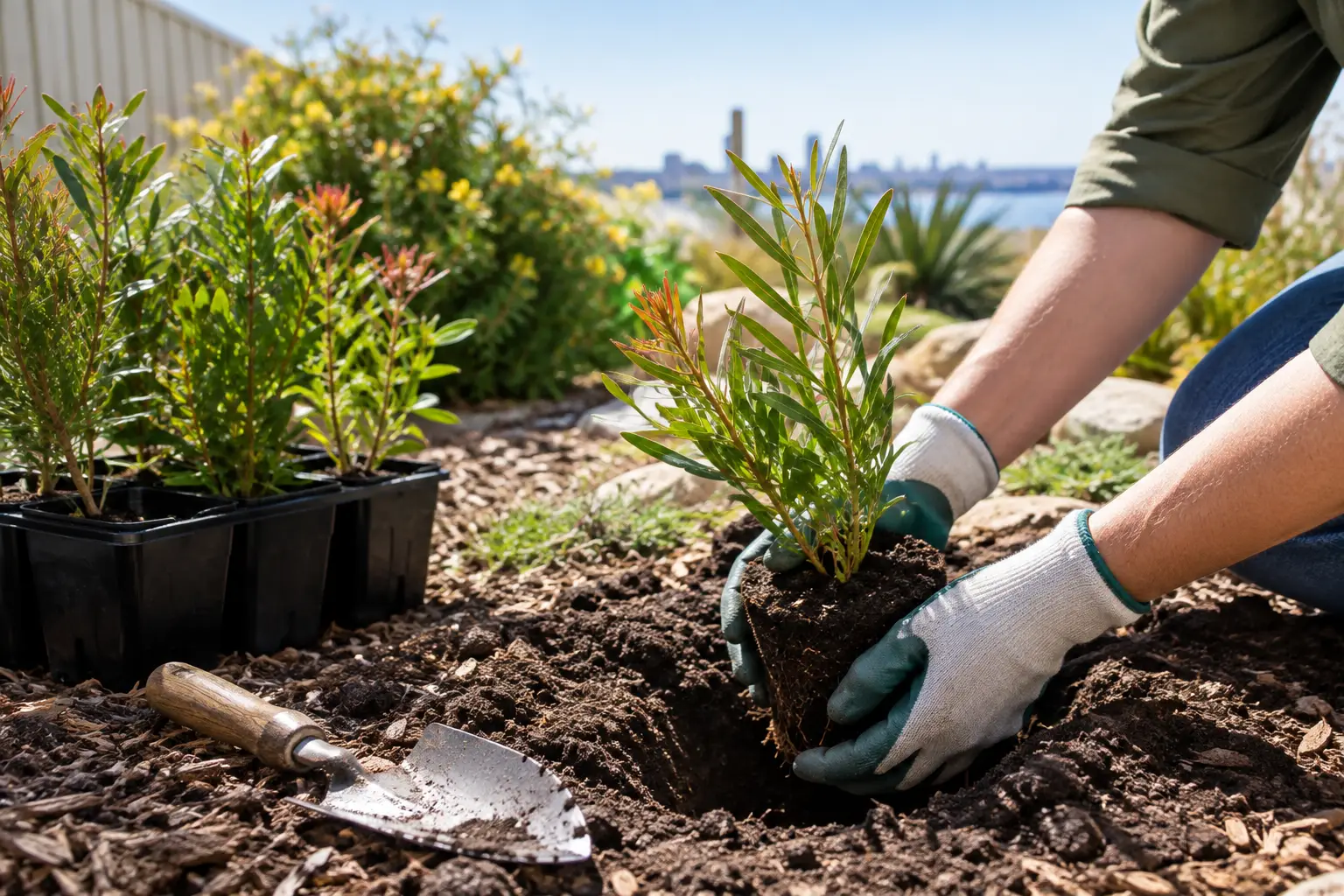
A small tube-grown plant can look a little underwhelming beside a mature garden shrub, but tubestock has one major advantage: it can settle into your soil early and develop a root system suited to your garden. Knowing how to plant tubestock properly makes the difference between a plant that takes off after its first season and one that struggles through a Perth summer.
Tubestock is usually a young plant grown in a narrow plastic tube. It is an economical way to establish hedges, native gardens, fruiting plants and mixed borders, especially when you need several plants. The trade-off is that young plants need more attention in their first year than a larger, more established specimen.
Start with the right spot
Before digging, check the plant’s likely mature size, sun requirements and tolerance for wind, frost and dry conditions. A screening shrub planted too close to a fence, or a sun-loving fruit tree placed in deep shade, will not be fixed by extra fertiliser later.
In Perth, full sun is often ideal for fruiting plants, grape vines and many Australian natives, but newly planted tubestock can still suffer in intense afternoon heat. A position with morning sun and some late-day protection can be useful for plants that are not built for hot, exposed sites.
Coastal gardens often have sandy soil, salt-laden wind and drying summer conditions. Inland areas, including Toodyay, can be hotter in summer and colder in winter, with frost a real consideration in lower or exposed spots. Choose plants and planting positions accordingly rather than treating Perth and inland WA as the same climate.
Prepare the soil before you plant
Good planting starts with soil preparation, not a bigger hole. Clear weeds and grass from an area around the planting site so they do not compete with the young plant for moisture and nutrients. Grass is particularly thirsty and can quickly overwhelm small tubestock.
Dig a hole about twice the width of the tube and roughly the same depth as the root ball. Avoid digging a deep, narrow pit. If the plant sits too low, water can collect around its stem and encourage rot. The top of the potting mix should finish level with, or just slightly above, the surrounding soil.
Perth’s sandy soils drain quickly and usually benefit from organic matter mixed through the wider planting area. A quality compost or well-rotted organic soil conditioner can improve moisture holding capacity. Do not make a rich little pocket surrounded by untouched sand, though. Roots need to move out into the surrounding soil, not stay circling inside a luxurious planting hole.
Heavy or compacted soils need a different approach. Loosen the surrounding ground and avoid planting when it is sticky and saturated. If drainage is poor, planting slightly raised can help, particularly for plants that dislike wet feet.
How to plant tubestock without damaging roots
Water the tube before planting if the mix is dry. Moist potting mix slides out more cleanly and is less likely to fall apart around the roots.
Hold the plant gently around the base, turn the tube upside down and squeeze the sides of the container. Do not pull the stem to remove it. If roots are growing densely around the outside, tease only the outer few roots loose with your fingers. For severely circling roots, make a few shallow vertical cuts down the root ball with clean secateurs or a knife. This encourages roots to grow outward rather than continue around in circles.
Place the plant in the hole, check the height, then backfill with the soil you removed. Firm it gently with your hands as you go to remove large air pockets, but do not stamp hard on the soil. Young roots need contact with the soil as well as air and water.
Make a shallow watering basin around the edge of the planting area, especially in sandy ground. This simple rim helps water soak down to the root zone instead of running across the surface.
Water deeply straight after planting. This settles soil around the roots and gives the plant its first proper drink in its new position.
Mulch, protect and stake where needed
Apply mulch after watering, leaving a clear gap around the stem. A layer about 5 to 8 cm deep is usually enough to reduce evaporation, moderate soil temperature and discourage weeds. Keep mulch several centimetres away from the trunk or stem because constant moisture against the plant can lead to collar rot.
In a windy coastal site, a new plant may need temporary support. Use a stake only when it is necessary, and tie the plant loosely with a soft, flexible tie. The stem should still move slightly in the wind, as this helps it develop strength. Remove the stake once the roots are established, often after one growing season.
Protection can matter just as much as watering. A simple guard may be useful where rabbits, pets or lawn equipment are likely to damage young stems. In hot weather, temporary shade cloth can help sensitive tubestock through its first few days, but do not leave a shade cover in place for a sun-loving plant long term.
Watering tubestock through a Perth summer
Tubestock has a small root system, so it cannot reach deep moisture straight away. For the first few weeks, check the soil regularly rather than watering by habit. Push a finger below the surface near the root zone. If it is dry, water slowly and thoroughly.
During warm, dry weather, new tubestock may need watering two or three times a week in sandy Perth soil. In a heatwave, daily checks are sensible, particularly for plants in full sun or windy positions. The aim is moist soil around the roots, not permanently soggy ground.
As roots grow outward, reduce the frequency and water more deeply. This encourages the plant to develop a stronger, more drought-resilient root system. Frequent light sprinkling keeps roots near the surface, where they are more vulnerable to heat and drying wind.
Different plants have different needs. Many Australian natives prefer leaner conditions and can react badly to overwatering or unsuitable fertilisers. Fruiting plants often need more consistent moisture while establishing and when actively growing. Read the needs of the plant you are buying rather than giving every tubestock the same treatment.
Timing your planting in WA
Autumn is often the easiest time to plant tubestock in Perth. The ground is still warm, winter rain helps settle roots, and plants have time to establish before the next hot summer. Winter is also suitable for many plants, provided the site does not stay waterlogged and frost-sensitive plants are protected in colder inland locations.
Spring planting works well when regular watering is possible. October is a busy planting time, but it is also when Perth gardens begin drying out quickly. Get new plants in early, mulch them properly and do not assume spring rain will do all the work.
Summer planting is possible, especially if a plant needs to go in straight away, but it requires closer attention. Plant in the cool of the morning or late afternoon, water in thoroughly and be ready to check moisture often. Waiting until autumn can be the better option for a plant going into a hot, exposed site.
Fertiliser and the first year of growth
Avoid the temptation to heavily fertilise a newly planted tube. The priority is root establishment. If you use fertiliser, choose one suited to the plant type and apply it lightly after the plant has begun settling in. Australian natives in particular may need a low-phosphorus product, while other garden plants can use a general slow-release fertiliser at the appropriate time.
Keep weeds away, top up mulch as it breaks down and monitor new growth for signs of stress. Wilting, leaf scorch and yellowing can come from several causes: dry soil, waterlogging, transplant shock, wind exposure or nutrient issues. Check moisture and drainage first before reaching for a product.
A little leaf drop after planting is not always a disaster. Plants can shed leaves while adjusting to different light, soil and watering conditions. Scratch a small section of bark with a fingernail – green tissue beneath usually means the plant is still alive and working its way through the change.
Give small plants a fair start
Tubestock rewards patience. It may spend its first months putting energy below ground rather than looking dramatic above it, but those roots are what support healthy growth later. Plant at the correct depth, water consistently through the first summer and keep competition away from the base.
If you are choosing plants for a new hedge, native planting, fruit garden or difficult Perth site, contact Buy My Plants to confirm current availability and discuss collection or local delivery arrangements. A young plant is a small beginning, but given the right start, it has plenty of room to become the part of the garden you were hoping for.