
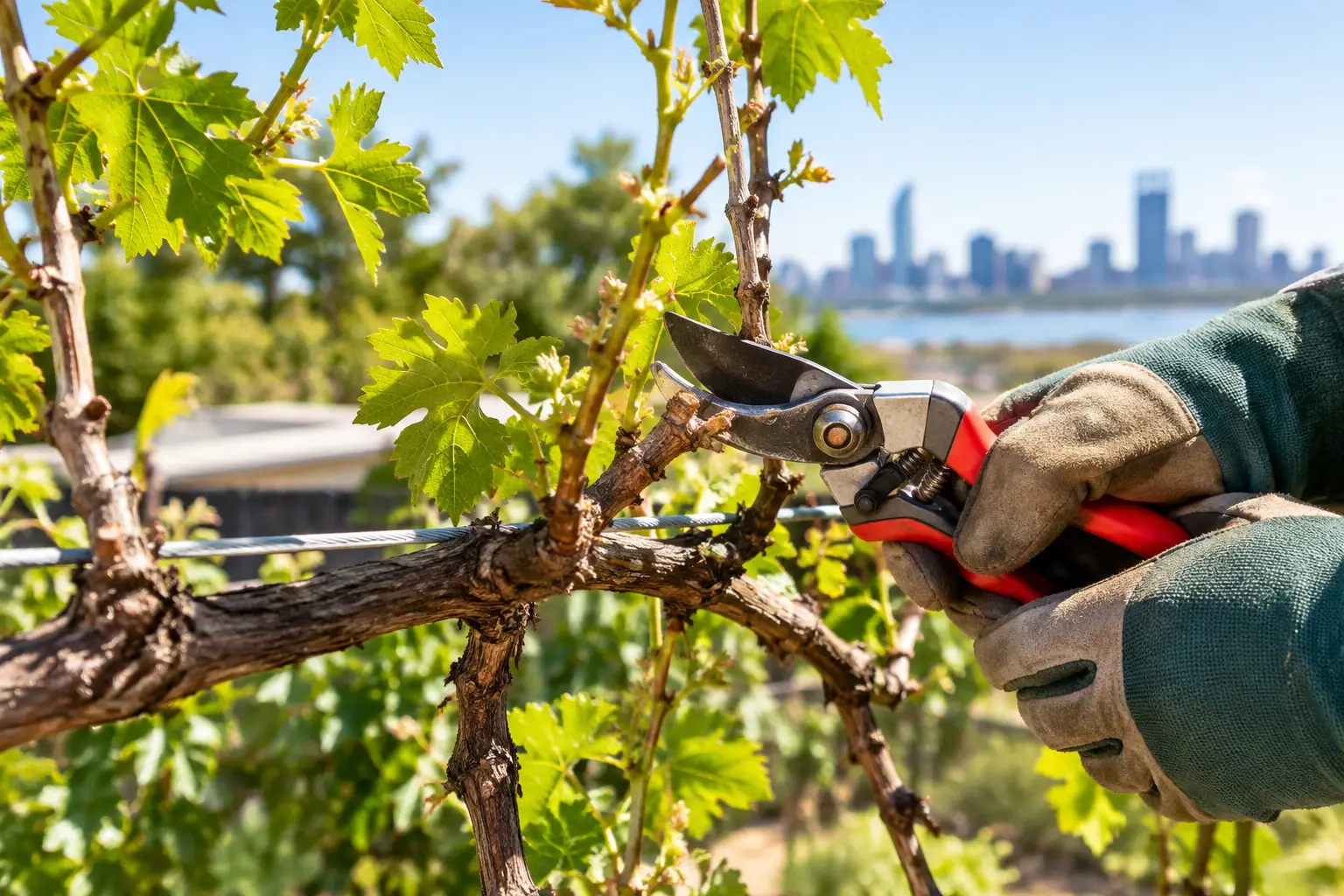
A grapevine can look like a tangle of bare sticks in winter, which makes the first hard cut feel a bit brutal. The good news is that grapes fruit on new shoots that grow from last year’s wood. Knowing when to prune grapevines is the key to keeping that growth productive rather than letting it scramble over the fence with plenty of leaves and very little fruit.
For most Perth gardens, the main prune happens in winter, while the vine is dormant. The exact week depends on your suburb, the weather and how exposed the vine is, but the job is usually done between late June and early August. A healthy established vine can be cut back hard. In fact, failing to prune it hard enough is one of the most common reasons vines become overcrowded and fruit poorly.
When to prune grapevines in Perth
Winter pruning is the major annual job. In coastal Perth, where winters are comparatively mild, July is often a practical time to prune. By then, most leaves have dropped and the vine’s framework is easy to see. Aim to finish before buds begin swelling and opening, which can happen early after a warm late winter.
If you are in a colder inland spot, including frost-prone areas around Toodyay, it can be sensible to wait until late July or August. Leaving pruning a little later may help delay budburst slightly, reducing the chance that tender new shoots are caught by a late frost. It is not a guarantee, but it is a worthwhile adjustment where frost is a regular concern.
Avoid doing the main prune in autumn while the vine still has green leaves. At that point it is moving stored energy back into its roots and permanent wood for next season. Also avoid cutting during very wet weather if possible. A dry day makes the work more pleasant and gives fresh cuts a better chance to dry cleanly.
What about pruning in spring and summer?
Grapevines also need light attention during the growing season. This is not the same as winter pruning. From spring onwards, remove shoots that are growing from the boot or base where they are not wanted, tie useful new shoots into their support, and take out obviously weak or crowded growth.
In summer, a little leaf and shoot management can improve airflow around bunches and help the fruit receive dappled light. Do not strip the vine bare, especially during a Perth heatwave. Grapes can sunburn, and leaves protect bunches from harsh afternoon sun. Think tidy and open, not naked.
Why winter pruning matters so much
A grapevine produces fruit on shoots that emerge from buds on one-year-old canes. Those canes are the stems that grew during the previous summer. If you leave every cane in place, the vine will produce a dense mass of shoots, leaves and small, shaded bunches.
A properly pruned vine has fewer shoots, but each one has better access to sun, air and the plant’s energy reserves. This generally means better fruit quality, less tangled growth and an easier vine to train over a pergola, wire frame or fence.
There is a trade-off. Pruning too lightly creates congestion, while pruning too hard on a young vine can slow down the development of the trunk and framework. The aim changes with the age and training style of the plant.
Before you cut: identify the main parts of the vine
Take a moment to look at the vine before reaching for the secateurs. The permanent boot and main arms are older, thicker wood with rough bark. They form the long-term structure and should not be removed by accident.
Last year’s canes are smoother and usually brown or reddish-brown. They grew in the previous season and carry the buds that can make next year’s fruiting shoots. Older, spent canes are often grey, rough and more branched.
Use sharp, clean secateurs for most cuts, with loppers or a pruning saw for thicker unwanted wood. Clean tools before starting, particularly if the vine has had disease issues. Make decisive cuts rather than crushing stems with blunt blades.
How to prune a young grapevine
In its first winter after planting, the priority is structure, not a crop. Choose the strongest main stem and remove competing weak shoots. If the vine has not yet reached its first training wire or support, cut it back to a healthy bud and let it focus on making a strong leader next spring.
Once the vine reaches the desired height, select shoots to form the main arms along the wires or frame. Keep the framework simple. One trunk with two arms is manageable for many backyard vines, although the right setup depends on the support you have built.
Do not be disappointed if a young vine takes a couple of seasons before it carries a worthwhile crop. Allowing it to overfruit too early can divert energy from establishing a strong root system and permanent framework. A well-built vine is much easier to manage for years afterwards.
Pruning an established grapevine
Established vines are commonly pruned using either spur pruning or cane pruning. The right method depends partly on the variety and how the vine has been trained. If you bought a named grape variety, it is worth checking whether it fruits reliably from buds close to the base of last year’s canes or performs better with longer canes retained.
Spur pruning
Spur pruning suits many backyard vines grown on a permanent framework. Along each main arm, retain short spurs spaced roughly a hand-width apart. Cut each spur back to two or three healthy buds. Remove the long, tangled canes that fruited last season, along with weak growth and any shoots pointing in unhelpful directions.
The result can look very bare. That is normal. Each retained bud can send out a new shoot in spring, and those shoots carry the season’s bunches.
Cane pruning
Cane pruning involves keeping one or two strong, well-placed one-year-old canes and tying them along the support. These are cut back to a set number of buds, while a shorter renewal spur is left nearby to provide next year’s replacement cane.
This method takes a little more planning because you are choosing next season’s fruiting cane and setting up the following season at the same time. It can be useful where a variety is less fruitful on short spurs. If you are unsure which system your vine needs, start by observing where it carried fruit last year and avoid making a major change all at once.
A simple pruning order for beginners
Start by removing dead, damaged or diseased wood. Then take out suckers from below the graft, if your vine is grafted, and shoots emerging from the boot where you do not need them. Next, remove crossing, thin and overcrowded canes so you can clearly see the permanent framework.
After that, choose whether you are retaining short spurs or selected fruiting canes. Make those cuts last. It is much easier to judge what to keep after the clutter is gone. If you are nervous, cut a little, step back, and look again. You can always remove another cane, but you cannot stick one back on.
After pruning: set the vine up for spring
Gather and dispose of prunings rather than leaving a thick pile at the base of the vine. This is particularly worthwhile if the plant showed signs of mildew or other disease during the previous growing season. Check ties, wires and posts while the vine is bare, replacing anything that may rub or constrict new growth.
Winter is also a good time to top up mulch around, but not touching, the boot. Keep the root zone clear of weeds and maintain even moisture once spring growth starts. Grapevines are tough, but newly planted vines and vines in sandy Perth soils still benefit from deep, sensible watering through dry weather.
If you are choosing a grapevine for a Perth garden, think first about the site. A sunny position, sturdy support and room for annual pruning matter more than having a large backyard. For current grapevine availability and collection or Perth delivery arrangements, contact Buy My Plants before making plans around a particular variety.
A winter-pruned grapevine may look like you have been ruthless, but spring will quickly prove otherwise. Give it a clear framework, leave the right young wood, and let the new season do the rest.