
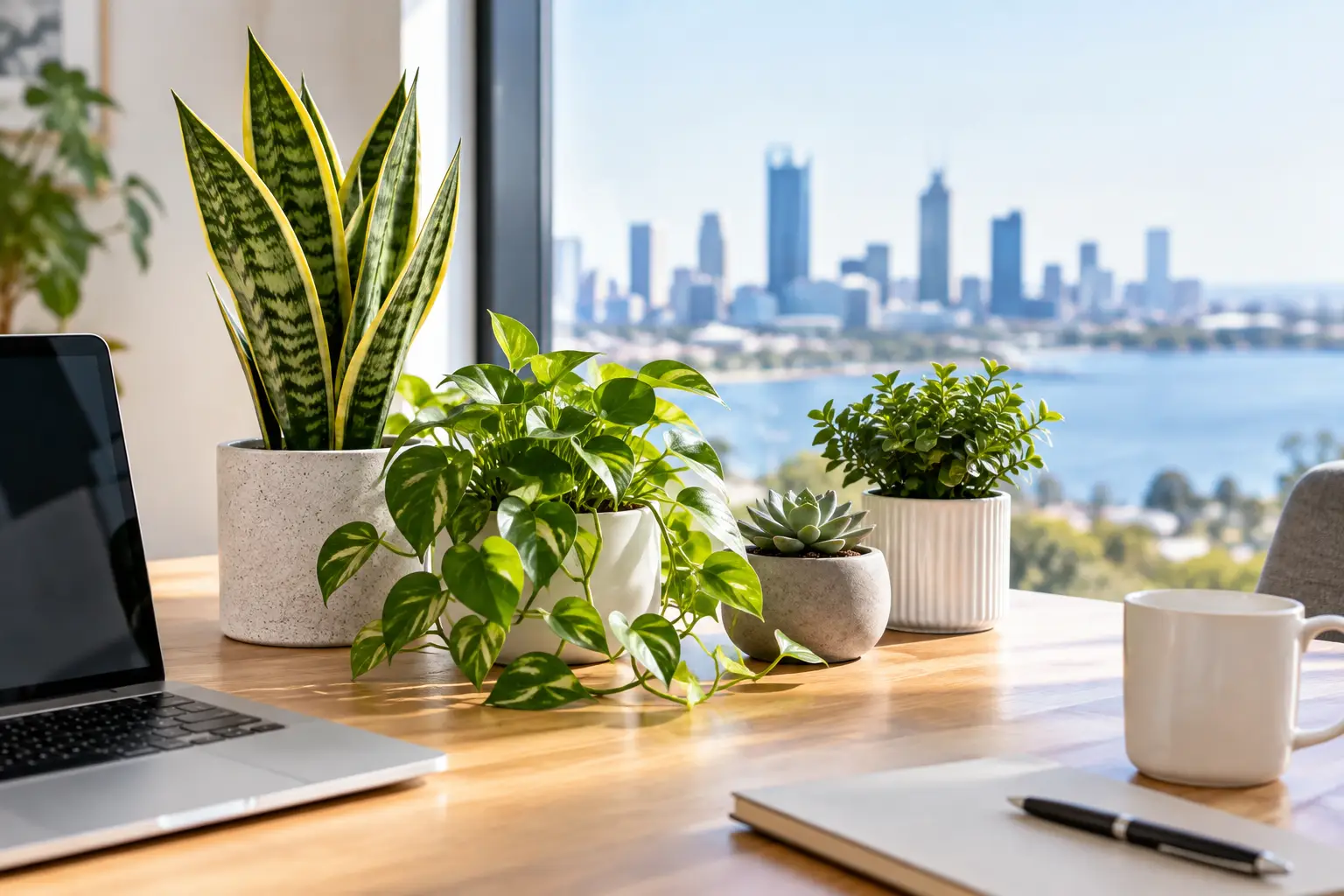
A desk plant has to earn its spot. It needs to cope with missed watering, dry air conditioning, a small pot and whatever light the desk actually receives. The best office desk plants are not necessarily the most dramatic plants in the nursery – they are the varieties that stay tidy, look good up close and suit the conditions of your workspace.
For Perth offices and home workspaces, start by looking at the light rather than choosing by leaf colour alone. A desk beside a bright north- or west-facing window is very different from one several metres back in a room with blinds down all day. Once you know that, choosing a plant becomes much simpler.
What makes a good desk plant?
The best choice is usually compact, forgiving and happy in a pot for a while. Large-leaf plants can look fantastic, but they quickly outgrow a desk and often need more consistent watering than a busy office can provide.
Also consider the people around the plant. A spiky succulent beside a shared keyboard area may not be practical, while trailing stems can become a nuisance near monitors, cables and drawers. Choose a plant with a neat growth habit, then place it where it will not be bumped every time someone reaches for a coffee.
1. Devil’s ivy
Devil’s ivy is one of the easiest desk plants to recommend because it adapts well to ordinary indoor conditions. Its heart-shaped leaves bring plenty of green without demanding a large pot, and it can handle bright indirect light or a moderately lit desk.
It is particularly useful if you want a plant that can eventually trail from a shelf or cabinet near the desk. Let the potting mix dry slightly between waterings rather than keeping it constantly wet. In a darker office, growth will slow and the leaf markings may become less pronounced, but the plant can still perform well.
2. Heartleaf philodendron
Heartleaf philodendron has a similar easy-going appeal, with glossy leaves and a softer, more compact look when young. It suits desks with filtered light and can be trained to trail neatly from a small pot.
This is a sensible choice for someone buying their first indoor plant. Keep it out of harsh afternoon sun through uncovered glass, which can scorch foliage, and trim longer stems if you want it to stay close to the pot.
3. Snake plant
For a desk that receives good natural light but does not get much attention, a compact snake plant is hard to beat. The upright leaves use very little desk space, making it a practical option beside a monitor or in a narrow reception area.
Snake plants prefer their potting mix to dry well between watering. Overwatering is the common mistake, especially in a cool air-conditioned office where soil takes longer to dry. A smaller specimen is usually the right desk purchase – save the tall, heavy pots for the floor.
4. ZZ plant
ZZ plants have thick, polished-looking leaflets and a naturally tidy shape. They are an excellent option for lower-light desks, provided there is still some ambient daylight in the room. They grow slowly indoors, which is a benefit when space is limited.
Like snake plants, ZZ plants store water in their roots and do not need frequent drinks. Water only when the potting mix has dried out substantially. If your desk has no natural light at all, move the plant to a brighter spot occasionally or choose a position closer to a window instead.
5. Peperomia
Peperomias are made for smaller desks. There are plenty of leaf shapes and colours available, from rounded green leaves to rippled and variegated forms, yet most stay nicely compact in a small pot.
They generally prefer bright, indirect light and a careful watering routine. Water when the upper layer of potting mix feels dry, then let excess water drain away. Their smaller size makes them easy to place on a desk, but it also means they dry out faster than a larger pot during Perth’s warmer months.
6. Chinese evergreen
Chinese evergreens offer patterned foliage for offices where light is limited but not absent. Their broad leaves make a desk feel greener without the plant needing to spread widely across the work surface.
They prefer warmth and steady indoor conditions, so avoid a spot directly under a strong air-conditioning vent. Water once the top of the mix has dried, and wipe dust from the leaves occasionally. Clean foliage looks better and lets you spot any pest issues early.
7. Aglaonema varieties
Many people use aglaonema as a name for Chinese evergreen varieties, but it is worth calling out because the range of foliage is a major selling point. Green, silver and pink-toned forms can add colour to a workspace without relying on flowers.
Choose a greener variety for lower light. More colourful selections generally need brighter indirect light to hold their best colouring. This is a good example of why buying based on your desk conditions, rather than just a photo, pays off.
8. Miniature peace lily
A compact peace lily can suit a bright office with filtered light, especially if you want lush green leaves and the chance of white flowers. It gives a softer look than upright plants such as snake plants or ZZ plants.
The trade-off is that peace lilies are less forgiving of dry potting mix. They often show they need water by drooping, then recover after a thorough drink. That can be helpful for beginners, but it is not ideal if nobody is in the office over a long weekend or holiday break.
9. Spider plant
Spider plants are a practical option for a bright desk, windowsill or hanging pot near a workstation. Their arching leaves add movement without taking up much room, and mature plants can produce small plantlets.
They appreciate regular watering during active growth, but do not leave them standing in water inside a decorative cover pot. If leaf tips turn brown, check whether the pot has dried too hard, the air conditioning is blowing directly on it, or fertiliser has been applied too often.
10. Haworthia and other compact succulents
A small succulent is ideal for the sunniest desk in the office. Haworthias are particularly useful because many tolerate bright indoor positions better than larger, sun-hungry succulents. Their compact rosettes also stay out of the way.
Succulents are not automatically low-light plants. Put them close to a bright window, rotate the pot every week or two, and water sparingly only after the mix has dried. A succulent on a dim desk will slowly stretch and lose its neat shape.
Match the plant to your desk light
Before buying, take a quick look at where the pot will sit. A desk directly beside a window with strong Perth afternoon sun needs a plant set back from the glass or protected by a blind. Devil’s ivy, peperomia and spider plants suit bright filtered light well, while a compact snake plant can cope with more sun if introduced gradually.
For a desk further inside the room, ZZ plants, snake plants and greener Chinese evergreens are usually safer picks. Low light does not mean no light, though. If you could comfortably work there with the lights off during the day, the plant has a better chance. A windowless desk needs artificial grow lighting or regular time in a naturally lit position.
Keep your desk plant looking good
The simplest care routine is to check the pot once a week rather than watering on a fixed schedule. Push a finger into the potting mix. If it is still damp, leave it. If the plant is ready for water, take it to a sink, water thoroughly and allow it to drain before returning it to the desk.
Always use a pot with drainage, or keep the nursery pot inside a decorative cover pot and empty any collected water. Direct air conditioning, hot window glass and forgotten water sitting around the roots cause more problems than a lack of specialised fertiliser.
When you are ready to buy, choose a healthy plant with firm leaves, no obvious pests and a pot size that suits the desk now. Buy My Plants can help Perth shoppers choose from current indoor plant availability, whether you need a compact first plant or a greener upgrade for a shared workspace. The right plant should make your desk feel better to sit at, not become another job on the weekly to-do list.